
Author: Asel Kasymova, tournament director at NUTS
Published: December 2026
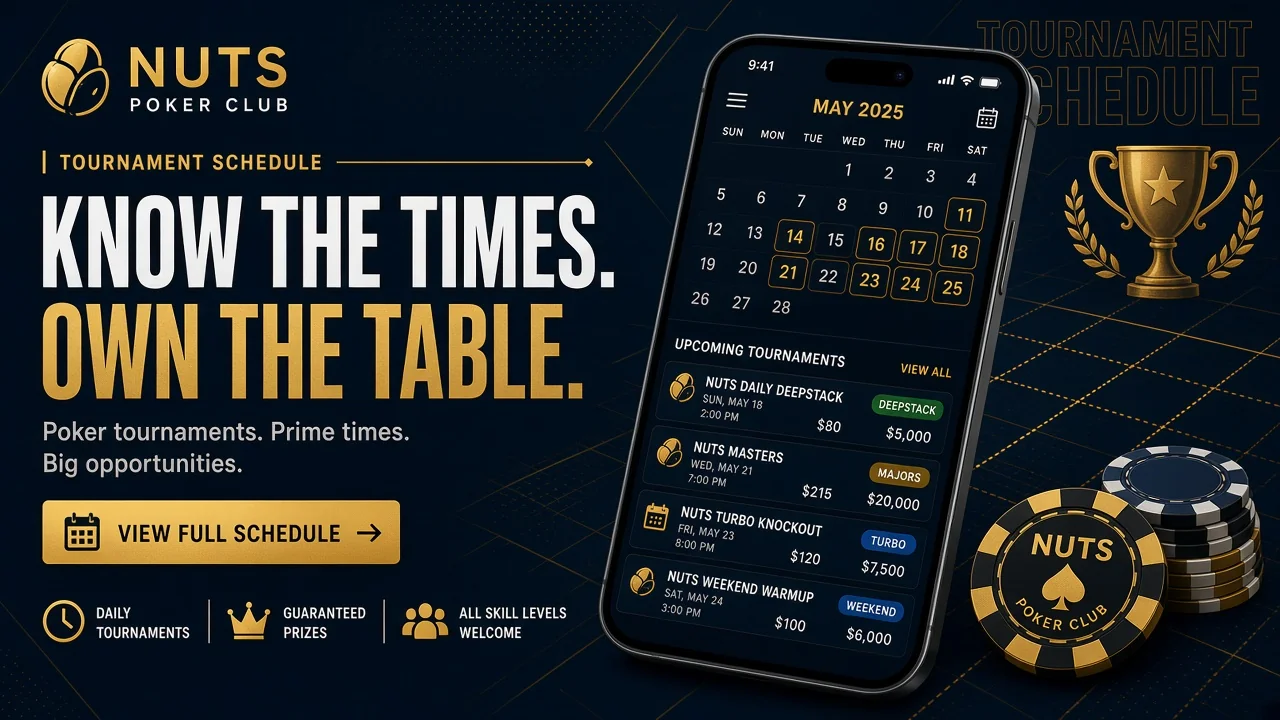
I am the tournament director at NUTS, and I am deliberately not printing an hourly grid here. Yesterday's event name can be gone from the lobby tomorrow, and the clock on the card still beats any sentence on the site. This article is about how to read the lobby of club 111777, not about what time to sit. The source of truth is the clock on the tournament card. If it disagrees with what you remember, the card wins.
Where the list lives
Open PPPoker, enter club 111777, and open Tournament. Those cards are live. If you are not in the club yet, start with joining: User ID, a confirmation, then a buy-in. Chips go through the bot @nuts111777bot. Until the request is confirmed, the tournament stays closed.
Extra events are announced by the manager @NUTSsup, not by a channel. I do not keep a hidden calendar in this article, and I am not asking you to catch an announcement somewhere else. If you write the manager about a specific tournament, send the name as it stands in the lobby now, plus your User ID. We can look at yesterday's screenshot. It cannot register you.
Fields on the card
The card is short. The muddle starts when someone reads one field and invents the rest. Six labels I want you to recognise before the register button.
- Buy-in. The cost of entry. Rake may already be inside that figure. Do not assume the whole amount reaches the prize pool until the card itself splits the fee.
- GTD or Guarantee. The guaranteed prize pool. That is the club's promise about prizes, not a promise that you will cash.
- Players. How many people are registered. The field changes while registration is open. A look in the morning and a look a minute before you decide are different numbers.
- Blinds. Starting blinds, or the current level if the event is already running. Read stack depth here, not from memory of a similar event.
- Late Reg. How late you can still sit. It is not a discount and not a full starting stack in big blinds.
- Re-entry. Whether you can enter again after you bust, and on what terms. If the line is missing, do not invent a second buy-in.
Overlay
Overlay is when the guarantee is larger than the sum of the buy-ins. The club covers the difference. That is one moment, not a series name. Open the card, add the buy-ins as stated, and compare the sum with the GTD. If people are still arriving, the overlay can shrink. Yesterday's overlay does not have to repeat. Rakeback, in rakeback and bonuses, does not replace the card, and an overlay does not cancel a bust.
Types you will meet in the lobby
The format name tells you the job of the stack. It does not tell you a start time, and it does not name a series. I will not assign a series that is not in the lobby.
- Freezeout. One entry. After you bust you cannot buy another life. An early mistake costs the whole bullet.
- Re-entry or Rebuy. A second entry exists only on the terms written on the card. The field can grow. That is not an automatic soft opponent and not a reason to enter without a limit.
- PKO. There is a reward for knocking a player out. You still need a stack to reach your own prizes. A knockout reward does not replace a payout place.
- Turbo or Hyper. Blinds climb fast and there is little time for postflop. A deep cash skill gets compressed into short decisions.
- Deepstack. The starting stack is deeper in big blinds, so there is more postflop. Still read the levels on the card: a deep start on a fast clock is a different event from a deep start on a long one.
The general machinery of a multi-table tournament, without today's lobby attached, is in the MTT article. If your working buy-in is small, also read microstakes. Position does not disappear on a deep stack: when there is still room for postflop in big blinds, the table position piece helps.
Late registration and re-entry
Late registration shortens both the clock and the stack. You pay the buy-in, sit at the current level, and hold fewer big blinds than someone who played the early levels. Part of the clock is already gone. A late seat is harsher in a turbo, and in a deepstack it eats the depth the format exists to provide.
Re-entry is not always +EV. A second buy-in is a new decision, not a continuation of an insult. If you busted and you want that same tournament back, stop and read what EV is. Sometimes keeping the buy-in is better than buying the same clock pressure again. Anger on the bubble is covered in tilt: an entry one second after you bust is usually an emotion, not a calculation.
Buy-in and bankroll
The coaching rule I give players is 100+ ABI: keep at least one hundred average buy-ins for the schedule you play regularly. It is a cushion for variance, not a promise of profit and not a club law. One good evening does not raise your ABI. The buy-in you are willing to pay again and again does. The arithmetic is in bankroll management. If you do not have one hundred buy-ins for the figure on the card, it is not your regular event, even when the guarantee looks thick.
Time without a timetable
Evening recreational fields are usually softer. I am not naming an hour or a series. Softness is the field on the card, not a promise that every evening is easy. Read Players and read the lobby clock. Moscow is UTC+3, and you still register by that clock, not by a retelling. Do not wait for a channel: an extra event is written by the manager.
Before I register I would say six things out loud: the buy-in and whether rake sits inside it, the guarantee, the player count, the blinds, the late-registration edge, and the re-entry rule. Then, separately: is there overlay right now, and is the stack shorter because the entry is late. If any answer is roughly, the button is early. Questions about a specific card go to the manager @NUTSsup, with the name from the lobby. Luck at the final table will not come from this article. It comes from the tournament you actually read before the click.
The page in one picture
lobby
beats any picture of the schedule
buy-in
may already include the rake
overlay
guarantee larger than the buy-ins paid
+2 h
a Moscow evening in Tashkent and Almaty
Short answers
Which field beats the picture?
The lobby. Read buy-in, guarantee, players, blinds, late registration, and re-entry there.
Is the buy-in a clean entry?
Not always. The Buy-in field may already include the rake.
What is an overlay?
The guarantee is larger than the buy-ins paid.
How do you shift a Moscow evening?
Tashkent and Almaty stay on UTC+5 all year. A Moscow evening is two hours later there.