
Author: Roman Shaposhnikov
Published: January 2027
Position is your seat relative to the button, not the rank of your two cards. The cards are random. The order of postflop action is not. The player who closes the betting has already seen the bets, the checks, and the sizes. The same hand from early position and from the button is therefore two different problems. At NUTS, club 111777, the cash games you will actually find are usually 6-max, and this article stays on that table.
What position is
Players mix up preflop and postflop more than anything else. The blinds are already in. Speech then goes UTG, MP, CO, BTN, and only then do SB and BB act before the flop. After the flop the order flips. The blinds speak first. The button speaks last. That second order is the button's information on three streets. Early position pays for the right to enter by having to answer first later.
The more players left behind you, the tighter the open. A seat gives information, and one loose call wastes it. If a loss makes you open UTG as wide as the button, that is tilt.
Six seats
Learn six labels and one job for each. The names stay in English because that is how they appear in a replay and at the table. The jobs are simple.
- UTG (Under the Gun) opens first. Almost the whole table is behind, so the range stays tight.
- MP (Middle Position) is a little freer, but several players still have a vote behind you.
- CO (Cutoff) sits in front of the button. Stealing starts here, and the button can punish a wide open with a 3-bet.
- BTN (Button) acts last postflop, steals wider, and controls the size of the pot.
- SB (Small Blind) is out of position for the rest of the hand. Versus an open, the practical line is often 3-bet or fold.
- BB (Big Blind) has already posted. Versus a button open, it defends wider for that reason.
Why the button beats UTG
On the button you see the folds and you can take the blinds with a wider open. If you are called, you still speak last on the flop, the turn, and the river. You can check back and keep the pot small, bet thin value when the opponent has shown weakness, or bluff the river after that player checks. That is pot control. Not every pot needs to grow.
Regulars win more from the button than from UTG because they have more information, not because the button deals kinder cards. I will not quote a bb/100 multiplier. The club does not publish one, and I will not invent one. Measure the edge on your own hands.
UTG is the opposite. You open, and five players can still enter or 3-bet. A wide bluff from here is expensive, because you finish the hand out of position. A tight early range is a refusal to pay for hands that die in a multiway pot.
A study sketch, not a solver printout
The opening percents below are for 6-max. They are a study sketch for practice, not a solver printout and not a secret club chart. A solver splits combos by size, stack, and frequency. The sketch exists so you do not open half the deck from UTG on a tired evening. Which hands sit inside each percent is in starting hands. How this differs from GTO is in GTO in the NUTS club.
- UTG is about 15% of hands. Big pairs, strong aces, a few strong suited hands. Too many people remain.
- MP is about 20%. Add medium pairs and some strong offsuit aces that should fold from UTG.
- CO is about 30%. Suited connectors and wider aces start to work, because the button and the blinds are most of what is left.
- BTN is about 45-50%. A steal: pairs, aces, connectors, suited kings and queens. You will be punished sometimes. That is the price of a wide steal.
A percent is not permission to play any 15% you feel like. If you cannot name the hands, you are playing a mood. Write the sketch down before the session and check it before you open.
The blinds
The small blind against an open is a bad place for a curious flat: you complete a partial blind and then speak first on every street. Versus an open, the practical fork is often 3-bet or fold. Against a tight UTG the 3-bet is narrower. Against a stealing button it is wider.
The big blind defends wider against a button open because one blind is already in the middle. That is not any two cards. Against a tight early open, defend tighter, because you are still out of position. Against a button near half the deck on this sketch, calls and 3-bets live wider. Pot odds do not cancel the postflop, where you act first. Decision versus result is in expected value.
After the flop
In position you can check back, bet thin value, or bluff a river after two checks. Out of position, check-raise hands that can stand a bigger pot and check-fold air. The player in position sees your check and can bet.
The usual mistake is one hand and one plan. AJo from UTG against a 3-bet often has neither position nor the lead, so a fold is a lesson. The same AJo on the button can open, because if you see a flop you act last. The seat changes the job before the ace changes its rank.
Who opened, and from where
A tight player who raises UTG is showing a strong slice of the sketch. A loose player on the button, after a run of folds, can hold anything in a wide half of the deck. Read the seat and the player type together. VPIP without a split by seat lies, because one percentage mixes a tight UTG with a wide button. If someone opens early almost as often as he opens on the button, his early range is not tight, and the sketch above is a weapon against him, not a script for him.
Before the first action, ask whether you will act last on later streets. One table at a limit your bankroll can stand beats four tables where you forget the button. Search club 111777 in PPPoker. The User ID goes out as the join guide says. Chips move through the bot @nuts111777bot. If 6-max is missing, or the request stalls, write @NUTSsup. Do not open a second profile.
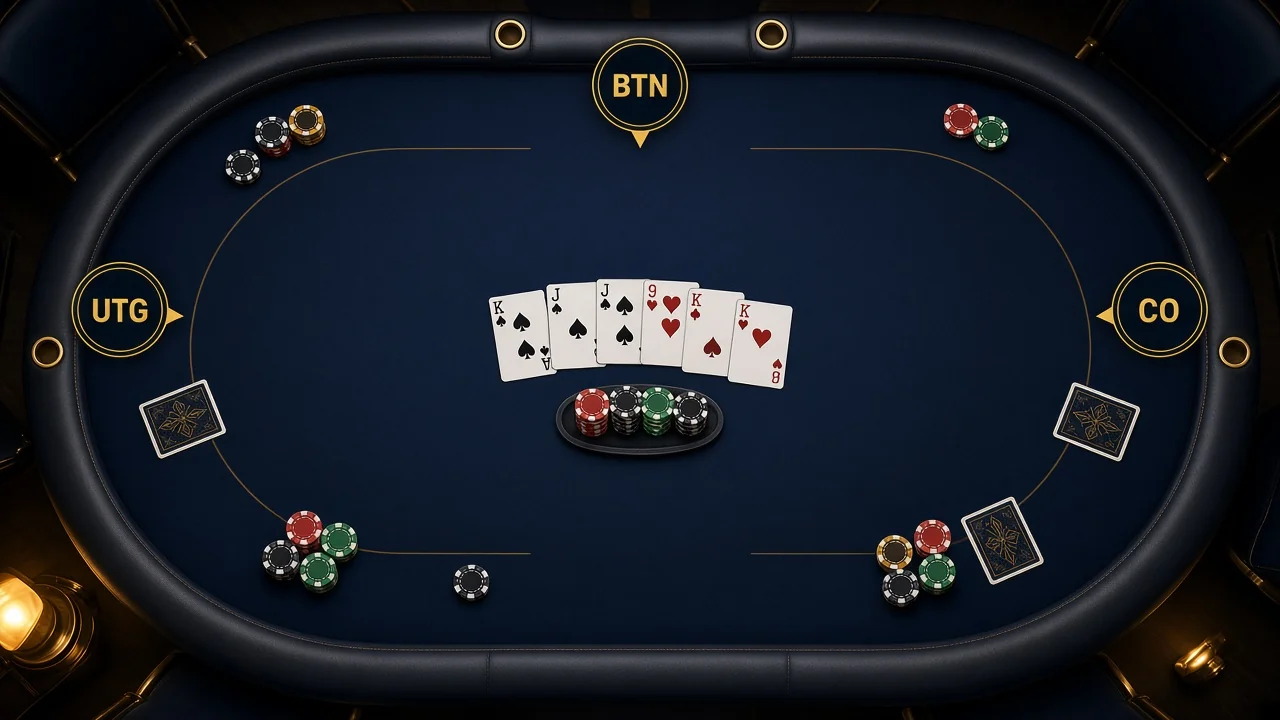
The page in one picture
button
acts last after the flop
early
tighter, because players remain behind
blinds
already invested, and they see everyone
compare
button with button, not with early
Short answers
Why is the button better?
After the flop the button acts last and sees the other decisions.
Does early position play as wide?
No. Players remain behind you, so the range is tighter.
Are the blinds a late position?
They have already posted, but after the flop they often act first.
How do you read a stat by seat?
Compare the button with the button. Do not move an overall number onto one seat.